• Skip to main content
  • Skip to primary sidebar

Reefwing Software

  • Home
  • Book
  • Development
  • Blog
  • Contact Us
  • Privacy
You are here: Home / Archives for Title Post

Title Post

April 4, 2026 by David Such Leave a Comment

Claude Code: Creating a C++ Linter for Embedded Development

I know! I’m late to the Claude Code party but now I’m here, I’m all in. If you write C++ for microcontrollers, or edge inference, you already know that the rules are different from desktop software. No heap allocation after startup. No exceptions. No recursion on a 4 KB stack. And these constraints are not optional if you want your firmware to survive.

The problem is that general-purpose linters do not enforce the rules you need. Clang-tidy is powerful, but configuring it to catch you just used int instead of int32_t, requires writing custom checks in C++ against the AST. That is a significant investment for what should be a simple rule. I wanted something I could tweak for each project.

Read More…

Filed Under: AI, App Development, Embedded, Title Post Tagged With: development, embedded AI

March 16, 2026 by David Such Leave a Comment

Learning to Claude Code

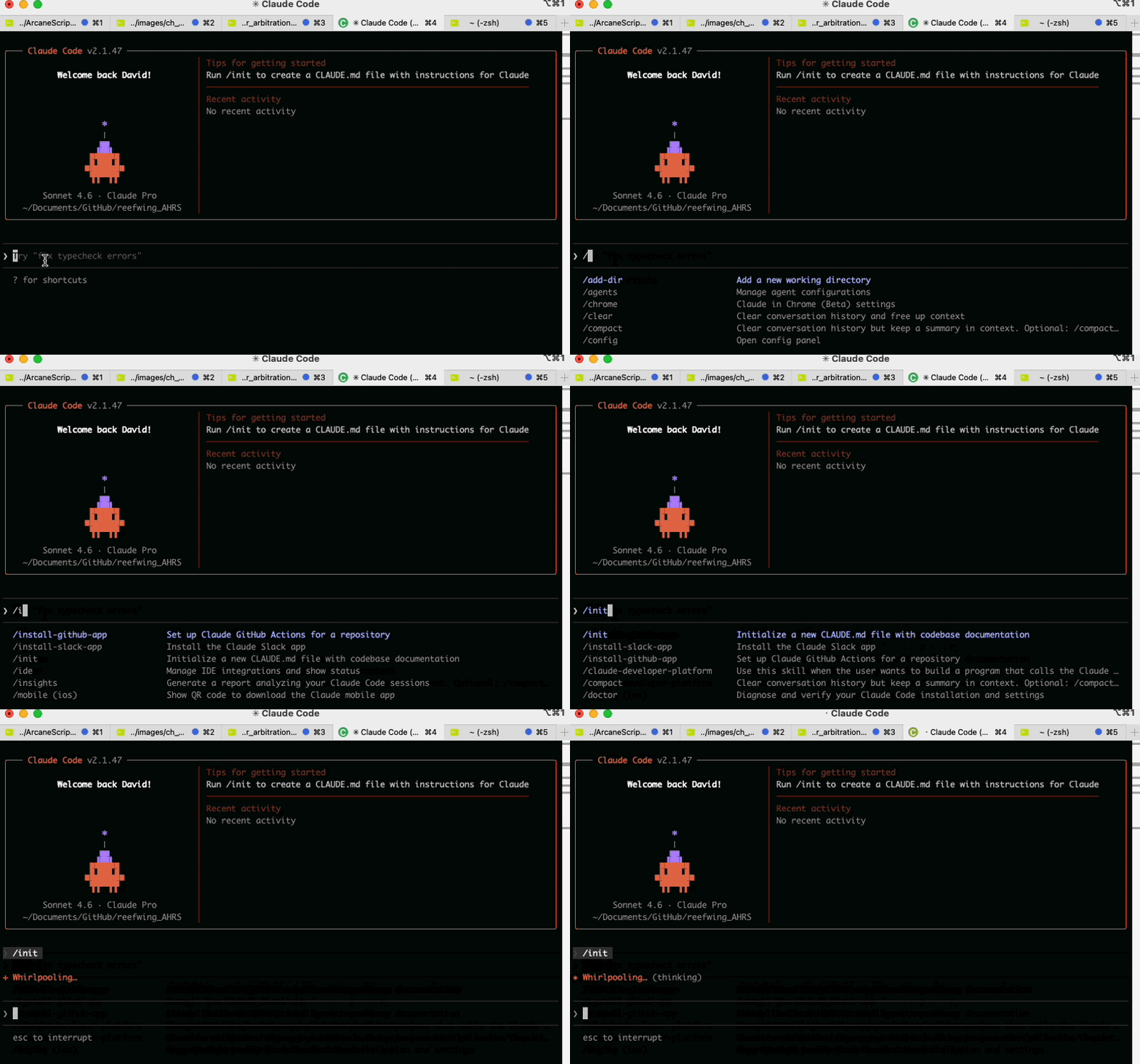
Up until now we have been using ChatGPT and Gemini to scratch our vibe-coding itch. But the future is agentic and a lot of folks swear by Claude so we thought we would give it a go and use the Anthropic Academy to learn how.

If you want to use Claude Code you are going to need at least a Pro account (i.e., pay Anthropic some money). There is an interesting tweet (what do we call them now?) by Boris Cherny about how he uses Claude Code. As its creator, his advice is credible. Boris runs five Claude’s in parallel in terminal and jumps between them as they spit out a result. He has another 5–10 Claude’s in the browser (http://claude.ai/code). We are going to start with a more modest single Claude and take it from there.

Read More…

Filed Under: AI, Embedded, Title Post Tagged With: embedded AI

March 16, 2026 by David Such Leave a Comment

What the F-35 can Teach us about Writing Safer Embedded C++

We recently came across the Joint Strike Fighter Air Vehicle C++ Coding Standards for the F-35 program. This was published by Lockheed Martin many years ago, but it contains some useful guidelines for coding C++ on embedded systems. The number one objective for the document was, the software must not fail.

Although written for military aircraft, the philosophy behind these rules applies directly to modern embedded systems. If you are building firmware for medical devices, robotics, automotive systems, or industrial control, this distilled guide captures the most practical lessons for your own C++ standards.

Our position on guidelines is that they need tailored for the application. Guidelines exist to reduce risk. The level of restriction they impose should match the level of consequence in the system. In life-critical systems the cost of failure is too high to optimise for elegance. If you are going to ignore a guideline, you had better know what you are doing. Coding standards should scale with the risk, and breaking a rule should always be an informed decision rather than an act of convenience.

Read More…

Filed Under: AI, Embedded, Title Post Tagged With: embedded AI

March 16, 2026 by David Such Leave a Comment

Hardwired Instincts: Designing PrimalBot’s Reflex Shield

Any bio-inspired robot needs hardwired instincts. That means giving PrimalBot the ability to sense its environment, protect itself, and react instantly, without waiting for the processor. To achieve this we had to design a custom shield that provides dedicated reflex circuits. On it, we’ve integrated:

  • Four hardware reflex loops that can bypass the controller and activate/stop the motors instantly.
  • A Pulse Width Modulation (PWM) generator to enable speed control of the motors.

The shield is designed to act like a robotic brainstem, handling the critical low-level functions that keep the system safe and responsive, while freeing higher-level layers to focus on learning, planning, and decision-making. In this article, we’ll walk through the design and simulation process of the reflex loops.

Read More…

Filed Under: AI, Embedded, Title Post Tagged With: embedded AI

March 16, 2026 by David Such Leave a Comment

Electronic Circuit Simulation on macOS

If you use a Mac for your development then your circuit simulation options are fewer than for Windows, but there are options.

The genesis of this article was a design for artificial reflexes. Our usual approach is to draw up the schematic and then jump straight to breadboarding. However, there are no off the shelf designs for electronic nerves so we didn’t know exactly how we would approach this problem. We needed to play around with components using different analog conditioning blocks until we got the required output. Simulation is the perfect use case for this scenario.

It seems like anytime you want to do something new, it involves learning another software package. Electronic simulation is no different. Whatever you end up using will probably have the word “spice” in it or be a thin wrapper around one of the SPICE engines.

Read More…

Filed Under: AI, Embedded, Title Post Tagged With: embedded AI

March 16, 2026 by David Such Leave a Comment

Quantum Neural Networks: Theoretical Heaven, Practical Hell

The pursuit of artificial general intelligence has long relied on silicon chips and the classical mathematics of vast, interconnected neural networks. But as datasets explode and computational demands become intractable, engineers are turning to a fundamentally different physical foundation: quantum mechanics. The result is the Quantum Neural Network (QNN), a new computational paradigm built on the mysterious physics of the qubit.

While QNNs offer potential exponential speedups and representational power that classic systems can only dream of, their practical development is currently defined by a thrilling engineering battle against quantum physics itself. Cue dramatic music…

Read More…

Filed Under: AI, Embedded, Title Post Tagged With: embedded AI

March 16, 2026 by David Such Leave a Comment

Sub-Cortical AI Model Design

The brain’s subcortical motivational architecture offers insight for AI development that current systems almost entirely miss. We believe the key to more general and autonomous AI lies in the ancient, sub-cortical engine. This is the system that provides the crucial why that directs the cortex’s how. It’s the source of goals, motivation, and value, transforming a passive processor into an active participant in the world.

Read More…

Filed Under: AI, Embedded, Title Post Tagged With: embedded AI

March 16, 2026 by David Such Leave a Comment

What Happens When We Outsource Our Brains to AGI?

You don’t remember phone numbers anymore. I don’t either.

We have, as a species, collectively agreed to outsource that small sliver of our memory to a silicon slab in our pocket. This isn’t a complaint; it’s a convenience. But it’s also a symptom of a much larger process, one we’re barely noticing. We are in the early, deceptively pleasant stages of cognitive offloading.

We offload our sense of direction to the GPS, our factual recall to Google, and, increasingly, our analytical reasoning to generative AI. We are trading cognitive friction for cognitive ease, and it feels good. But this frictionless convenience is, I believe, the single most dangerous, insidious threat of the 21st century.

We are all worried about the wrong AGI. We’re obsessed with a malicious “Terminator” AGI that will take power from us. We are completely ignoring the far more likely, benevolent AGI that will take responsibility from us. An AGI that we will willingly give our agency to, one frictionless decision at a time, until we have none left to give. This is the path to the Cognitive Conservatorship. And the scariest part? We’re already on it.

Read More…

Filed Under: AI, Embedded, Title Post Tagged With: embedded AI

March 16, 2026 by David Such Leave a Comment

Engineering “Instinct” in AI

Across species, evolution “pre-installs” compact neural programs that deliver immediate, reliable behaviors (standing, pecking, web-building) with minimal learning. What are the implications for designing AI?

The current approach to AI has a fundamental weakness: it’s incredibly hungry for data and experience. Today’s AI models start as a tabula rasa, or “blank slate,” and require massive datasets to learn even basic concepts about the world. They are brittle, struggle with common sense, and lack the efficiency that even a newborn animal displays moments after birth. A newly hatched sea turtle instinctively knows to crawl toward the ocean; a spider can weave a complex web without ever being taught.

This innate, pre-programmed knowledge is instinct. And by overlooking it, the AI field may be missing a crucial piece of the intelligence puzzle. Instead of just building better cortexes, perhaps we need to look deeper into the older, more foundational parts of the brain; the parts that give rise to instinct.

Read More…

Filed Under: AI, Embedded, Title Post Tagged With: embedded AI

March 16, 2026 by David Such Leave a Comment

How do MEMS Accelerometers Work?

Microelectromechanical systems (MEMS) sensors are a class of devices that combine mechanical and electrical components on a microscopic scale. These sensors are typically fabricated using processes like those used in semiconductor manufacturing, allowing for the integration of tiny mechanical structures with electrical circuits. MEMS sensors have revolutionized a wide range of industries due to their small size, low power consumption, and high functionality.

MEMS technology is used to create sensors that can measure various physical parameters, such as motion, pressure, temperature, magnetic fields, and even sound. Their compact size makes them ideal for applications where space and weight are critical, such as embedded systems. MEMS sensors also consume very little power, which is another reason that they are in common use. Most of the sensors that we use are based on MEMS technology.

Read More…

Filed Under: AI, Embedded, Title Post Tagged With: embedded AI

  • Page 1
  • Page 2
  • Go to Next Page »

Primary Sidebar

Embedded AI News

Recent Posts

  • Pi and the Mirage of Patternicity April 5, 2026
  • Claude Code: Creating a C++ Linter for Embedded Development April 4, 2026
  • The Missing Clock: Why Intelligence Needs Time March 29, 2026
  • Will Robots Evolve into Crabs? March 27, 2026
  • Learning to Claude Code March 16, 2026

Featured Posts

Pi and the Mirage of Patternicity

April 5, 2026 By David Such Leave a Comment

In April 2025, a claim began circulating online: pi is gradually increasing around the 7,237th decimal place. A math enthusiast in Cincinnati named April Simons had apparently flagged the anomaly. Prof F.O. Olsday, head of the Number Theory Group at Princeton, was quoted confirming it. Cosmologists were linking it to the accelerating expansion of the […]

Archives

  • April 2026
  • March 2026
  • April 2024
  • March 2024
  • February 2024
  • January 2024
  • November 2023
  • October 2023
  • July 2023
  • June 2023
  • May 2023
  • April 2023
  • March 2023
  • November 2022
  • September 2022
  • August 2022
  • July 2022
  • April 2022
  • March 2022
  • February 2022
  • January 2022
  • October 2021
  • August 2021
  • July 2021
  • June 2021
  • February 2021
  • November 2020
  • October 2020
  • May 2020
  • April 2020
  • January 2020
  • November 2019
  • October 2019
  • September 2019
  • July 2019
  • June 2019
  • May 2019
  • March 2019
  • January 2019
  • December 2018
  • October 2018
  • September 2018
  • August 2018
  • July 2018
  • June 2018
  • May 2018
  • March 2018
  • January 2018
  • December 2017
  • November 2017
  • October 2017
  • September 2017
  • August 2017
  • July 2017
  • June 2017
  • April 2017
  • February 2017
  • January 2017
  • December 2016
  • November 2016
  • October 2016
  • September 2016
  • July 2016
  • May 2014
  • April 2014

Search

Copyright © 2026 · Executive Pro on Genesis Framework · WordPress · Log in