• Skip to main content
  • Skip to primary sidebar

Reefwing Software

  • Home
  • Book
  • Development
  • Blog
  • Contact Us
  • Privacy
You are here: Home / Archives for Title Post

Title Post

March 16, 2026 by David Such Leave a Comment

Quantum Neural Networks: Theoretical Heaven, Practical Hell

The pursuit of artificial general intelligence has long relied on silicon chips and the classical mathematics of vast, interconnected neural networks. But as datasets explode and computational demands become intractable, engineers are turning to a fundamentally different physical foundation: quantum mechanics. The result is the Quantum Neural Network (QNN), a new computational paradigm built on the mysterious physics of the qubit.

While QNNs offer potential exponential speedups and representational power that classic systems can only dream of, their practical development is currently defined by a thrilling engineering battle against quantum physics itself. Cue dramatic music…

Read More…

Filed Under: AI, Embedded, Title Post Tagged With: embedded AI

March 16, 2026 by David Such Leave a Comment

Sub-Cortical AI Model Design

The brain’s subcortical motivational architecture offers insight for AI development that current systems almost entirely miss. We believe the key to more general and autonomous AI lies in the ancient, sub-cortical engine. This is the system that provides the crucial why that directs the cortex’s how. It’s the source of goals, motivation, and value, transforming a passive processor into an active participant in the world.

Read More…

Filed Under: AI, Embedded, Title Post Tagged With: embedded AI

March 16, 2026 by David Such Leave a Comment

What Happens When We Outsource Our Brains to AGI?

You don’t remember phone numbers anymore. I don’t either.

We have, as a species, collectively agreed to outsource that small sliver of our memory to a silicon slab in our pocket. This isn’t a complaint; it’s a convenience. But it’s also a symptom of a much larger process, one we’re barely noticing. We are in the early, deceptively pleasant stages of cognitive offloading.

We offload our sense of direction to the GPS, our factual recall to Google, and, increasingly, our analytical reasoning to generative AI. We are trading cognitive friction for cognitive ease, and it feels good. But this frictionless convenience is, I believe, the single most dangerous, insidious threat of the 21st century.

We are all worried about the wrong AGI. We’re obsessed with a malicious “Terminator” AGI that will take power from us. We are completely ignoring the far more likely, benevolent AGI that will take responsibility from us. An AGI that we will willingly give our agency to, one frictionless decision at a time, until we have none left to give. This is the path to the Cognitive Conservatorship. And the scariest part? We’re already on it.

Read More…

Filed Under: AI, Embedded, Title Post Tagged With: embedded AI

March 16, 2026 by David Such Leave a Comment

Engineering “Instinct” in AI

Across species, evolution “pre-installs” compact neural programs that deliver immediate, reliable behaviors (standing, pecking, web-building) with minimal learning. What are the implications for designing AI?

The current approach to AI has a fundamental weakness: it’s incredibly hungry for data and experience. Today’s AI models start as a tabula rasa, or “blank slate,” and require massive datasets to learn even basic concepts about the world. They are brittle, struggle with common sense, and lack the efficiency that even a newborn animal displays moments after birth. A newly hatched sea turtle instinctively knows to crawl toward the ocean; a spider can weave a complex web without ever being taught.

This innate, pre-programmed knowledge is instinct. And by overlooking it, the AI field may be missing a crucial piece of the intelligence puzzle. Instead of just building better cortexes, perhaps we need to look deeper into the older, more foundational parts of the brain; the parts that give rise to instinct.

Read More…

Filed Under: AI, Embedded, Title Post Tagged With: embedded AI

March 16, 2026 by David Such Leave a Comment

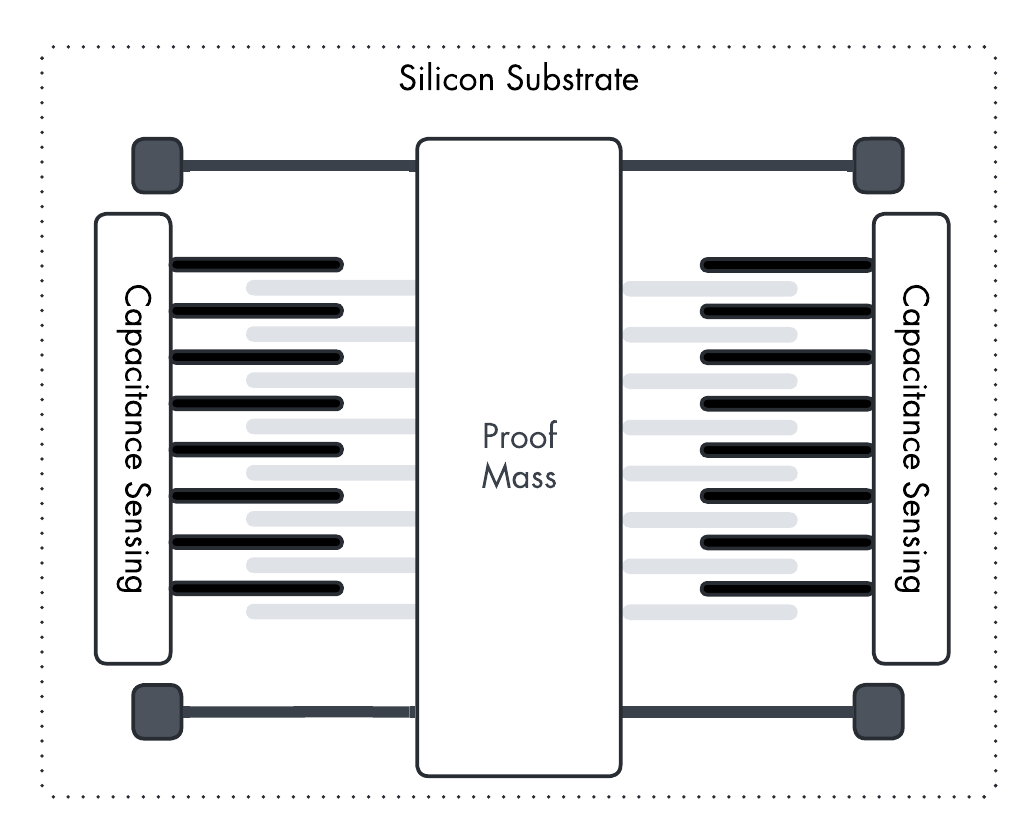
How do MEMS Accelerometers Work?

Microelectromechanical systems (MEMS) sensors are a class of devices that combine mechanical and electrical components on a microscopic scale. These sensors are typically fabricated using processes like those used in semiconductor manufacturing, allowing for the integration of tiny mechanical structures with electrical circuits. MEMS sensors have revolutionized a wide range of industries due to their small size, low power consumption, and high functionality.

MEMS technology is used to create sensors that can measure various physical parameters, such as motion, pressure, temperature, magnetic fields, and even sound. Their compact size makes them ideal for applications where space and weight are critical, such as embedded systems. MEMS sensors also consume very little power, which is another reason that they are in common use. Most of the sensors that we use are based on MEMS technology.

Read More…

Filed Under: AI, Embedded, Title Post Tagged With: embedded AI

March 16, 2026 by David Such Leave a Comment

Embedded System Design Principles

This is a subject that deserves its own book, and indeed, many have been written, but our goal here is to give you a solid head start. Whether you’re building your first IoT gadget or optimizing firmware for a custom PCB, there are some time-tested principles that can help you steer clear of classic mistakes. By following these principles, you can create your own unique problems rather than recreating those already made by others. These aren’t rules to blindly follow, but patterns worth understanding and adapting. Even small design decisions can have big consequences.

Read More…

Filed Under: AI, Embedded, Title Post Tagged With: embedded AI

May 11, 2014 by David Such 1 Comment

Development Complexity & Price

Difficulty

It is difficult to calculate how difficult an app will be to build, but it can be useful to know this when developing a quote for an app. There are a few different approaches that you can take.

You could use Halstead complexity measures which are software metrics introduced by Maurice Howard Halstead in 1977 as part of his treatise on establishing an empirical science of software development. Halstead made the observation that metrics of the software should reflect the implementation or expression of algorithms in different languages, but be independent of their execution on a specific platform. These metrics are therefore computed statically from the code using the following:

For a given problem, Let:

  • \,\eta_1 = the number of distinct operators
  • \,\eta_2 = the number of distinct operands
  • \,N_1 = the total number of operators
  • \,N_2 = the total number of operands

From these numbers, several measures can be calculated:

  • Program vocabulary:

\eta = \eta_1 + \eta_2 \,

  • Program length:

N = N_1 + N_2 \,

  • Calculated program length:

\hat{N} = \eta_1 \log_2 \eta_1 + \eta_2 \log_2 \eta_2

  • Volume:

V = N \times \log_2 \eta

  • Difficulty :

D = { \eta_1 \over 2  } \times { N_2 \over \eta_2 }

  • Effort:

E =  D \times V

The big problem with this approach is that you can’t calculate the metrics until you have written the code. This is problematic at the quotation stage of a project.

Our approach is based more on heuristics (i.e. educated guessing). By completing the following quick questionnaire we can come up with a score out of 100 which approximates the complexity and hence development effort required. This is used as an input into calculating the number of hours required and ultimately the cost.

Reefwing Complexity Matrix

  1. How customised is the user interface? Score from 0 for using the provided UI elements to 20 for a totally customised UI. Most game apps score a 20 for this, as everything from the buttons to the navigation bars need to be customised to suit the game theme. Utility apps are more likely to get a low score.
  2. How complicated is the underlying data model? This could vary from 0 for no persistent data to 20 for server based data. Using SQL or Core Data (for iOS) would be somewhere in the middle.
  3. How complex is the app? This relates to the app objective and may influence the other considerations. For example, an app with low complexity may simply display data. The other extreme would be an app that performs route mapping or language recognition. This dimension is a measure of what you are trying to do, the previous question on the data model is an element of how you are solving the problem. A lot of games can be surprisingly complex, an example of this would be if you were trying to build a decent AI for a 3D environment. Complexity will also influence how much code you will need to write which in itself will make life more difficult (have a look at the Halstead equations above).
  4. Who, what or how does the app have to communicate? You would score a 0 for this if the app was stand alone. The score would rise with the scale and type of networking required. You would also take into account how the networking was performed (e.g. Bluetooth, Wi Fi, etc) and how robust it needed to be (redundancy?).
  5. Does the app require 3rd party libraries or API’s? This could be ad servers, geo location, language recognition, translation services or anything similar. Score 0 for none and increase the score based on the number of interfaces. We also vary the score based on the maturity of the API and the API provider.

Once you have calculated your complexity score by adding the results from the five questions above you will get a number out of 100. We segment our apps into the following categories:

  • > 80: Insane:: You probably need to double the price you first thought of. Complexity increases exponentially (not linearly) with added elements because they all interact with each other.
  • 60 – 80: Difficult:: In this range you would double check everything and ensure that you have a tight specification. This app will likely take you longer than you expect and throw up things that you don’t expect. Add an extra 25 – 50% contingency.
  • 40 – 60: Average:: Most apps will fall into this range, no extra contingency should be required as long as the specification is solid and you have wire frames.
  • 20 – 40: Easy:: Should be a walk in the park. A good place for beginner developers to start.
  • 0 – 10: Simple:: There can never be too many fart apps.

We haven’t seen any other attempts to model app complexity but we would love to hear about the practices or thoughts of other developers.

Filed Under: App Development, Title Post Tagged With: app, calculating, degree, development, difficulty, estimate, quote, quoting

April 30, 2014 by David Such Leave a Comment

Marketing your App

marketing

Building the greatest app in the world means very little if nobody can find it. Marketing considerations are a critical aspect of any app launch. This is true now more than ever, as the app store becomes more and more competitive.

Most developers have processes and checklists around app development prior to go live, like testing on multiple devices. What about a checklist for app marketing prior to go live? Below is an App Marketing & Go Live Checklist (courtesy of AppReporting.com) that we like to go through before we launch an app.

Marketing Checklist:

  • Include Social Media Integration Within the app. Allow users to share via Facebook, Twitter etc
  • Include Email Share features. Word of Mouth Marketing! Allow your users to email their friends about your app.
  • Include direct feedback option. Allow users to submit feedback and comments within the app. Getting negative reviews hurts! Reduce the odds of negative comments by allowing your users to provide feedback directly to you with your app.
  • Promote and entice ratings within your app. Ratings are a form of marketing for your app, a very important form. Getting positive ratings is critical. Ask user to rate and review your app, within your app. I posted about this here: How to Get More (& Positive) App Reviews and Ratings
  • Online Marketing- create a dedicated website for your app. These days hosting is inexpensive. With most major hosts you can do a one click install of WordPress and using a free (and responsive, so it plays well on mobile) theme you can be up and running in little time. A website is key because you can link your Press Releases back to your website and App Review Requests. Your website will earn links and eventually rank in Google and other search engines for search queries related to your app. This form of online marketing will help your app get more installs by driving search traffic from the search engines.
  • Social Media- create a Facebook page for your app. Create a Twitter account for your app. Publicize your social media accounts on your dedicated app website.
  • Optimize Your App Description. Using keyword research (Google Keyword Planner) create a strategy for your app. Ensure your app title, description and keywords are optimized for a strategic keyword. Once your app page is optimized focus attention to optimizing your dedicated app website.
  • Design an amazing app icon and screenshots. This is the most overlooked by app publishers. Your potential app users are very design focused… both app stores and centered mainly on app icon images. Remember someone looking for your app is really looking at your app icon first, along side dozens of your competitors icons. If your icon doesn’t stand out, they will simply click on your competitors icon. I have seen so many truly great apps that fail because the icon is poorly designed. Look at your app icon next to your competitors icon before you launch your app and see if it stands out well, ask yourself “would I click on my icon or one of the others?”
  • Create a Press Release for your app. Post it on your dedicated app website.. and post it to press release sites.
  • Create a short video demo of your app. Post it to YouTube. Share it in your Press Release.. share it when you request app reviews.
  • Prepare for app review requests. There are hundreds of websites that review apps.. many for free. Once your app is live- submit it to these sites to get reviews and links to your app. Include your press release and video url with your request. Our team can do this work for you and submit your app to over 155 iPhone app Review Sites or over 115 Android App Review Sites.
  • Research related blogs to your app. Every App has an audience and for every audience there are blogs. Research blogs that are on the same topic of your app. Find the related site, contact details, Facebook profiles. When your app is ready you can reach out and network with these sites to help market and promote your app. You can share your Press Release and YouTube Video and you can kindly request a review of your app. You can also offer to guest post on their blog in return for a link back. You can do this work yourself, or have our team assist by researching 100 related blogs to your app.

Filed Under: App Development, Title Post Tagged With: app, marketing

April 28, 2014 by David Such Leave a Comment

The Care & Feeding of Your Developer

PastedGraphic-1

You have decided that your business needs an app, so what is the best way to ensure that you get what you want?

Well you could follow the App Happening four step framework:

  • Concept, Marketing & Viability
  • Design & Specs
  • Build & Approve
  • Launch & Support

This is a best in class solution for getting the app you want, at the lowest cost, in the shortest possible time. App Happening provides free marketing tips, app concept templates, strategy guides, development timelines and even an eBook on creating a successful app (http://www.apphappening.com/ah/appbuildingguides). So why does (almost) nobody use these? I suspect the reason is a combination of, “too hard”, “why bother” and “I just want to get started”!

As a Developer, I’m not too worried about whether your app is going to sell well or deliver on your business case. My job is to deliver the app you specified at the cost I bid and within the agreed time frame. If you have reached the stage of hiring a Developer, I assume that you have already worked out that the cost and effort is worthwhile. If not, then I suggest that you go and have a look at the Concept, Marketing & Viability section (http://www.apphappening.com/ah/conceptmarketingviability) of the web site.

I’m also assuming that you have a clear idea of what your app will do, because if you don’t, explaining the concept to me will be difficult. I don’t need a complete Functional Description and fully laid out screen shots initially but I need enough to be able to provide you a price and how long the development process will take. Before going into the bare minimum specification requirements, I would like to discuss why the specification step is important.

How to spend a lot of Money and NOT get what you want!

PastedGraphic-2

If you have ever renovated a house you will know that the cheapest time to modify the design is before construction start. It is exactly the same for app development. You want to have a very good idea of the outcome before you start. Sooner or later you will need to make decisions about what the app will do and what it will look like. Given this fact, doesn’t it make sense to do it at the beginning? I guarantee that if you do, it will save you money and reduce frustration.

There are generally two ways that you can engage a Developer:

1. Fixed price; or
2. Hourly rate.

If you choose to go the hourly rate route then you could just make it up as you go along (some people call this AGILE development) but it can become expensive. If you select the fixed price approach, it is much more important that you get the definition phase correct. Do not assume that a feature that you want is included in the design, if it hasn’t been explicitly specified then your developer hasn’t costed it and it is unlikely to end up in the final product. Assumptions in the design phase of fixed price contracts lead to disputes, which waste everyones time and energy.

design

I have enough stress in my life…

If the specification of your app consists of something like “i need a game built in 1 week for a fixed price of $100”, don’t be surprised if no developers bid on it (what game? what platform? what device? what???). The level of design specification required depends on where you are in the development cycle. If you just want indicative pricing to plug into your business model then simple dot points which describe the objective, functionality and target platform (e.g. iOS or Android) are probably sufficient – just be up front with the Developer.

If you are committed to building an app then I’m afraid that I’m going to direct you back to the App Happening website page (http://www.apphappening.com/ah/designspec) on Design and Specification. It is in your interests to specify the app as fully as possible. You should include the Developer in this process if possible. Start with your simple dot point functional specification. Your Developer can tell you what is technically possible on a particular platform and what is possible but difficult (i.e. expensive). Once you have a good idea of app functionality, sketch up some indicative screen shots (wire frames), pen and paper is fine. Alternately get the Developer to suggest something. You want these wire frames to be low fidelity so that people are comfortable playing around with the design and changing them. The combination of the Functional Spec and the Wireframes will give you a flow diagram or flow map which describes how users will move around your app. Make sure that key functional screens are at the top of your navigation stack.

If your Functional Spec is detailed enough, the data base design (if required) will fall out of this. For a people based app, you may want to save information like name, address, phone, favourite colour, etc. Consider whether you think the data model will change in the future, if the ability to update and migrate data models isn’t built into the original design it can be expensive to retrofit it.

If you follow the above suggestions, your Developer will be in the best possible position to assure you get what you want, when you want it.

Filed Under: App Development, Title Post Tagged With: app, development

April 28, 2014 by David Such 3 Comments

Why Your Business Needs An App

innovation

What are five ways that you can harness the power of mobile apps?

If you decide to have an app built for your business, it’s important to be clear about your objectives from the start and strategise around them:

1. To disrupt a market (or prevent you from being disrupted).

According to Wikipedia (http://en.wikipedia.org/wiki/Disruptive_innovation), disruptive innovations are those that “improve a product or service in ways that the market does not expect, typically first by designing for a different set of consumers in the new market and later by lowering prices in the existing market.” Experience has shown that you want to be the one doing the disrupting (just ask Kodak or Encyclopaedia Britannica). The Economist (http://www.economist.com/node/21530920) estimates that there will be 20 billion mobile connected devices by 2020, this provides app developers with direct access to most of your customers. You could consider mobile devices as viruses infecting your customers and apps are the payload. Uber (https://www.uber.com/) is an example of an app which is disrupting the limousine/taxi business. It provides a better service (the app knows where you are and you can see where your vehicle is in real time) and creates customer stickiness. Uber knows who the customers are and manages payment (taking their percentage off the top), the Limousine Companies no longer own the relationship which is the beginning of the end. Could someone do this to your business?

2. Apps provide another channel into your business. 

Mobile is quickly becoming the preferred e-commerce channel. 7 out of 10 online consumers access multi-channel retailers through one or more digital channels. In addition, there is a growing trend towards self service. Most call centres are experiencing year on year 20-30% decreases in phone calls, as customers move their enquiries to other channels (e.g. web and mobile). People expect to be able to change their preferences or order a goods or service no matter where they are or what time it is. If you don’t provide this capability, your competitors will.

3. An app can help build brand strength. 

Intuit have built an app called Mint (https://www.mint.com/what-is-mint/) that aggregates your financial life in one place. The Banks need to be careful that they don’t become a commodity. Any time someone gets between you and your customer, you have lost control of the relationship and of the customer experience. This makes it very easy for you to be replaced by someone else. Conversely, Domino’s have built an app which gives you a pizza store in your pocket. It allows you to browse through all the products on their menu, customise your own pizza (1.8 billion pizza combinations!), design your order, choose pick up or delivery and best of all track exactly when your order is ready in store or when it’s going to arrive at your front door. This app creates customer loyalty.

4. To deliver additional revenue.

If the preceding reasons haven’t convinced you then perhaps a business case will. How can a business be confident that the financial return justifies the initial investment and ongoing expenses? I’m afraid that only you can put together that business case but the 900,000 apps on iTunes and a similar number on Google Play suggest there is something there. Some factors to consider, when building your business case:
Increased sales by having a one to one relationship with customers;
Elimination of inbound calls through customer self service;
Reduced handling time and mistakes through automated process; and
Increased revenue through advertising5. It allows you to compete with anyone anywhere.

The last reason for you to build an app is that it provides you with a force multiplier. This is a concern for large established business and an opportunity for new start ups. In the new digital world, you don’t need expensive property in the main street of town to be successful. Anyone can develop a professional app which is a window to your services. Apps (and web sites) are the great equalisers. More and more goods and services are being procured and fulfilled electronically. Your business needs to embrace this trend.
This blog was first posted on the App Happening web site (http://blog.apphappening.com/5-reasons-business-needs-app/)

Filed Under: App Development, Title Post

  • « Go to Previous Page
  • Page 1
  • Page 2
  • Page 3
  • Go to Next Page »

Primary Sidebar

Embedded AI News

Recent Posts

  • A Chip That Thinks using 7 μW June 1, 2026
  • Who is Liable for Onboard AI? June 1, 2026
  • The Godfather of AI Claims a Multi-modal AI had a Subjective Experience May 28, 2026
  • Creating an Index for a Technical Book using AI May 28, 2026
  • Your Brain Has a Real Estate Problem, and Dreams Might Be the Solution May 16, 2026

Featured Posts

A Chip That Thinks using 7 μW

June 1, 2026 By David Such Leave a Comment

Most AI research is about making the cortex bigger. This one is about making the spinal cord cheaper. A team at the University of Michigan has built a tiny computing device that controls a balancing propeller using about seven millionths of a watt. For comparison, the LED bulb in your kitchen burns through about ten […]

Archives

  • June 2026
  • May 2026
  • April 2026
  • March 2026
  • April 2024
  • March 2024
  • February 2024
  • January 2024
  • November 2023
  • October 2023
  • July 2023
  • June 2023
  • May 2023
  • April 2023
  • March 2023
  • November 2022
  • September 2022
  • August 2022
  • July 2022
  • April 2022
  • March 2022
  • February 2022
  • January 2022
  • October 2021
  • August 2021
  • July 2021
  • June 2021
  • February 2021
  • November 2020
  • October 2020
  • May 2020
  • April 2020
  • January 2020
  • November 2019
  • October 2019
  • September 2019
  • July 2019
  • June 2019
  • May 2019
  • March 2019
  • January 2019
  • December 2018
  • October 2018
  • September 2018
  • August 2018
  • July 2018
  • June 2018
  • May 2018
  • March 2018
  • January 2018
  • December 2017
  • November 2017
  • October 2017
  • September 2017
  • August 2017
  • July 2017
  • June 2017
  • April 2017
  • February 2017
  • January 2017
  • December 2016
  • November 2016
  • October 2016
  • September 2016
  • July 2016
  • May 2014
  • April 2014

Search

Copyright © 2026 · Executive Pro on Genesis Framework · WordPress · Log in