• Skip to main content
  • Skip to primary sidebar

Reefwing Software

  • Home
  • Book
  • Development
  • Blog
  • Contact Us
  • Privacy
You are here: Home / Archives for 2026

Archives for 0

September 25, 2026 by David Such Leave a Comment

The Sunset of the Independent Edge AI Chip

As semiconductor giants acquire edge AI startups and build neural processing directly into standard chips, what happens to the pioneers who helped bring AI onto our devices?

In this episode, we explore how edge AI is shifting from a specialized product to an everyday feature. We examine why increasingly complex language models are challenging early chip designs, how software and developer communities are becoming crucial to survival, and why standalone accelerators are being squeezed out of the market.

Could this consolidation bring faster, more private AI to everyone—or narrow the field of innovation just as it’s getting interesting?

Filed Under: AI, Embedded, IoT, Robotics Tagged With: embedded AI, podcast

September 23, 2026 by David Such Leave a Comment

Groupthink — Why AI Agent Groups Fail

In 1985, the psychologists Garold Stasser and William Titus ran what became one of the most replicated experiments in group decision-making. Four-person groups had to choose among three candidates for student body president. Each candidate was described by sixteen characteristics. The trick was in the distribution. The best candidate’s virtues were scattered across group members so that no individual could see the full picture, while a mediocre candidate’s virtues were known to everyone. The complete evidence pointed clearly to one answer. Each individual’s data pointed in the wrong direction.

When every member received all the information, 83 percent of groups chose the best candidate. When the information was distributed, 18 percent did.

This August, Anthropic ran the same test on teams of four AI agents deciding realistic questions: which candidate to hire, which investment to make, which property to buy. Shared evidence favored the wrong option. Each agent held unique, decisive private facts favoring the right one. Solving the task required an agent to recognize its private information as pivotal and press it against an apparent consensus.

A single agent handed the entire evidence base got the answer right nearly every time. Groups of agents, after discussion, got it right in 17 to 36 percent of runs for most model families. 

Read More…

Filed Under: AI, App Development, Embedded, Robotics Tagged With: embedded AI

September 19, 2026 by David Such Leave a Comment

Building an NFC-Powered PCB Business Card for Embedded AI

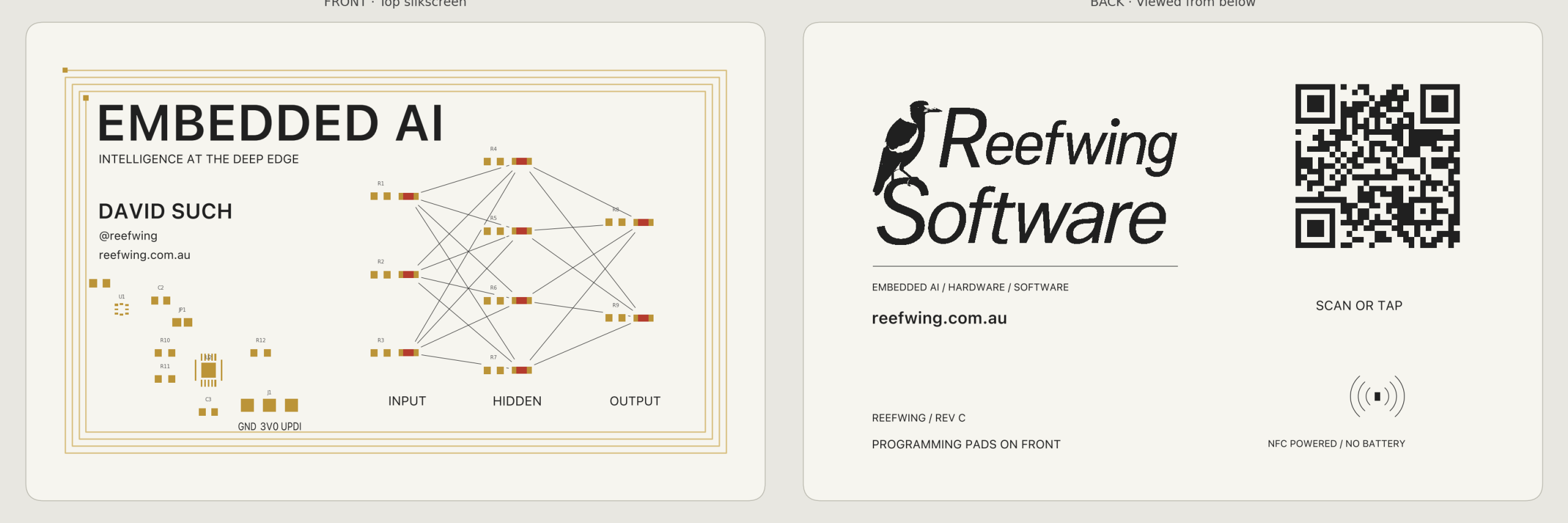
Tap a phone on the card and nine LEDs light up in sequence that emulates a neural network. The whole thing runs on whatever energy a mobiles NFC field can push into a loop of copper on a credit-card-sized PCB (about 5 mA at 2 V).

The card is to promote my new book, Embedded AI: Intelligence at the Deep Edge (No Starch Press), and Reefwing Software, the company behind it. Front Side: the book title, my name and the LED network. Back Side: Reefwing branding, a QR code, the web address and three programming pads. Both the NFC tag and the QR code point at a short URL.

The NFC business card is an open-source hardware and software project, with the design files and code released under the MIT licence. The Reefwing Software repository includes the EasyEDA schematic and PCB layout, artwork, Arduino firmware and programming instructions, so you can build your own card, adapt the design or use it as a starting point for another project. The design is still a prototype, so check the repository’s validation notes before ordering boards.

Read More…

Filed Under: AI, Embedded, IoT Tagged With: Arduino, development, embedded AI

September 17, 2026 by David Such 1 Comment

The Intellectual Event Horizon: Can an AI Model Know What Nobody Taught It?

On 20 May 2026, an unreleased OpenAI model produced a counterexample to a conjecture Paul Erdős made in 1946. Nine world-class mathematicians reviewed the construction and found it sound. On 8 September, ten thousand agents working for 88 hours produced a singularity in the three-dimensional Navier-Stokes equations, formally verified in Lean, resolving a Millennium Prize problem. Neither result was in any training corpus, because neither existed.

This episode asks what actually happened. If a model generates a proposition that was never in its training data, is that discovery or hallucination? The uncomfortable answer is that at the moment of generation they are the same operation. Nothing in the sampling process distinguishes a true novel claim from a false one. The partition is imposed afterwards, from outside, by a verifier the model does not run.

We work through the 2026 evidence on both sides. Yan and colleagues at ACL measured the unverifiable output space across 32,400 generations and found that only 4.7 percent of it qualifies as creative synthesis rather than groundless fabrication. Kalai and colleagues at OpenAI argue that models hallucinate because training rewards guessing over admitting uncertainty, which means the disposition to conjecture is optimised for rather than accidental. Meanwhile the computability literature argues that some irreducible error rate is mathematically necessary for any model family we can actually build.

The conclusion is that the ceiling on machine knowledge is not the training corpus. Every confirmed case of machine-originated knowledge this year paired a generative model with a verifier that was not a language model: a proof assistant, a code executor, a cell viability assay. The generator supplies variation and something outside it supplies selection, which is the structure of evolution by natural selection. That makes the event horizon domain-shaped rather than knowledge-shaped. Mathematics has a perfect verifier and is falling quickly. Fields without an oracle will not move by this route, regardless of how important they are.

We close on the edge angle. A model deployed on a device is a proposer operating without a verifier. A robot’s grasp either holds the object or drops it, and that is a selector. This is the strongest available argument that embodiment is not decorative.

This episode is a sequel to “Large Language Monkeys: Why Noise Yields No Knowledge” (S6E7), which argued that a random source contains no knowledge because nothing selects the signal. Here we ask what happens when a selector exists.

Referenced in this episode: Quanta Magazine on the Erdős problems and on Navier-Stokes; Yan et al., ACL 2026; Kalai, Nachum, Vempala and Zhang, arXiv 2509.04664; AlphaEvolve and FunSearch; Shumailov et al., Nature 2024 on model collapse.

Filed Under: AI, Embedded, Robotics Tagged With: embedded AI, podcast

September 13, 2026 by David Such Leave a Comment

You need a Reflex Layer Because — Shannon

Why inference rate, not intelligence, decides which layer keeps the robot alive.

Six blind men are asked to describe an elephant. The one at the trunk reports a snake, the one at the leg a tree, the one at the ear a fan. None of them is wrong. Each has a correct local measurement of a surface he cannot see the whole of, and the argument only starts when they compare notes. The same problem occurs when you try to describe intelligence and even for what should be a very straight forward concept — bandwidth.

A machine learning researcher, a computer vision engineer and a control engineer walk into a bar. Ask them what the bandwidth of a neural network is and you get three clammy hands on the same metaphorical elephant. The first will tell you about spectral bias, the tendency of a network to learn low frequency structure in its input before fine detail. The second will tell you about aliasing in feature maps and why you blur before you downsample. The third will ask what the sample period is, because to a control engineer the bandwidth of anything in a loop is set by the loop frequency. All three are measuring bandwidth. None of the three measurements have anything to do with the other two.

Read More…

Filed Under: AI, Embedded, Robotics Tagged With: embedded AI

September 7, 2026 by David Such Leave a Comment

Garbage In, Garbage Out is not always True for AI

What a 741 op-amp says about training networks on data that is 99 per cent wrong.

The open-loop gain (A) of an LM741 is a minimum of 20,000 and typically 200,000. A ten to one spread, on the parameter that defines the part sounds like a problem. It doesn’t matter because nobody uses the open-loop gain. Instead, you wrap the amplifier in two resistors, and the closed-loop gain becomes approximately 1/β (β is the resistor ratio). The transistor specifications inside the amplifier can be as sloppy as they like. To confirm, calculate the closed loop gain: with A = 20,000 the closed-loop gain is 9.995, with A = 200,000 it is 9.9995. A ten to one variation in the active device becomes a 0.005 per cent variation at the output. The 1 per cent tolerance resistors are the important spec.

This is why “garbage in, garbage out” is a half truth in any system with feedback. A feedback loop does not need accurate components. It needs an accurate reference. Whether that distinction carries over to training and running neural networks turns out to be a well studied question, and the answer is the same as for the op-amp, right down to the caveat.

Read More…

Filed Under: AI, Embedded, Robotics Tagged With: embedded AI

September 5, 2026 by David Such Leave a Comment

Why Businesses Don’t Automate

A large paint company documents four ways to process a purchase order. In reality there are 11,973 different approaches. That gap between the documented process and the real one is the subject of this episode, and it explains why AI adoption is near universal while the share of companies reporting any profit impact has been flat at 37 percent for two years.

We look at where the difficulty actually sits. The process lives in workarounds, spreadsheets and people’s heads, and is different at every site. The data is spread across roughly 900 applications of which a quarter are connected. Legacy systems were never designed to be called by a machine. And the law has started to get involved: Air Canada was held liable for what its chatbot said, Workday can be sued as an employer’s agent, Australian companies must disclose automated decisions from December 2026, and Commonwealth Bank reversed AI-attributed redundancies after call volumes went up rather than down.

We then cover what AI adds to the old problem. Language models are non-deterministic and cannot be replayed for audit. The best agents complete about 30 percent of realistic office tasks. Human oversight runs into limits Lisanne Bainbridge described in 1983, now measured in the field. And people feel faster while being measurably slower.

Finally, what works. The strongest predictor of financial return is not the model but whether the workflow was redesigned, which is the same lesson factories took forty years to learn from electrification. We walk through the method: mine the process, standardise the core, exclude the tail explicitly, run in shadow mode against a baseline, measure at the process level, and tier governance by consequence. #embeddedAI #podcast

Filed Under: AI, Embedded Tagged With: embedded AI, podcast

August 30, 2026 by David Such Leave a Comment

Embedded AI Book – PCBWay Offer

Five of the projects in my book on Embedded AI are built using custom PCBs: the Noise Suppression carrier board for the Raspberry Pi Pico 2, the Pico MIDI Keyboard and VS1053 Synthesizer that form the AI music project, and the Battery Monitor and Display & Logging shields that make up the battery characterization rig. These are circuits that do not work well on a breadboard, so each was designed as a proper board with the Gerbers, schematics, and bills of materials released under the MIT license. Getting them manufactured is straightforward: all five are shared projects on PCBWay with the fabrication files already attached, so ordering takes a few clicks and boards typically arrive within one to two weeks. To make building the projects even more affordable, PCBWay is offering readers a discount.

PCBWay is offering 200 readers of Embedded AI a $10 discount on orders over $30 (one use per user). Redeem the code EmbeddedAI2026 at checkout. The code is valid until April 30, 2027 (once activated, it must be used within six months). Each board costs around $5 but shipping is roughly $25 (depending on your location), so order the boards together to minimise freight, and the combined order will clear the $30 minimum.

https://www.pcbway.com/project/member/?bmbno=994A3415-F0F1-41

Filed Under: AI, Embedded, Marketing Tagged With: development, embedded AI, marketing

August 29, 2026 by David Such Leave a Comment

Large Language Monkeys: Why Noise Yields No Knowledge

There is an old claim that a truly random source contains all knowledge: give monkeys enough time at typewriters and Shakespeare falls out. In 2024 two Sydney mathematicians did the arithmetic and found the universe ends first. But the idea has a modern tail. We now have language models that can spot meaningful text instantly, so why not let randomness generate and an LLM extract? This episode works through why that fails, and why the failure is precise: in a random stream, the address of any text costs as many bits as the text itself. Along the way: Borges’ Library of Babel, a website that actually built it, DeepMind systems that made the generate-and-filter idea work by cheating in exactly the right way, and what your brain does with noise that an LLM cannot.

Filed Under: AI, Embedded Tagged With: embedded AI, podcast

August 29, 2026 by David Such Leave a Comment

The Language LLMs Need Is Not the One Being Built

Vibe coding did not make the programming language irrelevant. It changed which properties of a language matter.

While vibe coding my latest application I got to thinking about whether someone needed to create a computer language which explicitly targets LLMs. Assuming we get to a point where you don’t need to review the underlying code (a big assumption I know), then does the language used matter as long as you get the required outcome?

If a human never reads the code, the argument goes, why generate syntax built for human eyes at all? Proposals are being circulated for machine-native formats. For example, JSON programs, semantic graphs, and languages with grammars minimised for constrained decoding. The premise is that human readability is an obsolete requirement we can now delete.

I think the premise is wrong, but the question underneath it is good. There is real value in a language designed around how LLMs fail. It just looks nothing like a machine-native syntax, and the solution has already been found.

Read More…

Filed Under: AI, App Development, Embedded Tagged With: embedded AI

  • Page 1
  • Page 2
  • Page 3
  • Interim pages omitted …
  • Page 6
  • Go to Next Page »

Primary Sidebar

Embedded AI News

Recent Posts

  • The Sunset of the Independent Edge AI Chip September 25, 2026
  • Groupthink — Why AI Agent Groups Fail September 23, 2026
  • Building an NFC-Powered PCB Business Card for Embedded AI September 19, 2026
  • The Intellectual Event Horizon: Can an AI Model Know What Nobody Taught It? September 17, 2026
  • You need a Reflex Layer Because — Shannon September 13, 2026

Featured Posts

The Sunset of the Independent Edge AI Chip

September 25, 2026 By David Such Leave a Comment

As semiconductor giants acquire edge AI startups and build neural processing directly into standard chips, what happens to the pioneers who helped bring AI onto our devices? In this episode, we explore how edge AI is shifting from a specialized product to an everyday feature. We examine why increasingly complex language models are challenging early […]

Archives

  • September 2026
  • August 2026
  • July 2026
  • June 2026
  • May 2026
  • April 2026
  • March 2026
  • April 2024
  • March 2024
  • February 2024
  • January 2024
  • November 2023
  • October 2023
  • July 2023
  • June 2023
  • May 2023
  • April 2023
  • March 2023
  • November 2022
  • September 2022
  • August 2022
  • July 2022
  • April 2022
  • March 2022
  • February 2022
  • January 2022
  • October 2021
  • August 2021
  • July 2021
  • June 2021
  • February 2021
  • November 2020
  • October 2020
  • May 2020
  • April 2020
  • January 2020
  • November 2019
  • October 2019
  • September 2019
  • July 2019
  • June 2019
  • May 2019
  • March 2019
  • January 2019
  • December 2018
  • October 2018
  • September 2018
  • August 2018
  • July 2018
  • June 2018
  • May 2018
  • March 2018
  • January 2018
  • December 2017
  • November 2017
  • October 2017
  • September 2017
  • August 2017
  • July 2017
  • June 2017
  • April 2017
  • February 2017
  • January 2017
  • December 2016
  • November 2016
  • October 2016
  • September 2016
  • July 2016
  • May 2014
  • April 2014

Search

Copyright © 2026 · Executive Pro on Genesis Framework · WordPress · Log in